Forex Trading Terminology for Beginners: 30 Must-Know Forex Terms
Forex trading terms for beginners can make your trade simple and easy, but at first these terminologies feel overwhelming. Words like pip, leverage, and spread create confusion — for example, not knowing that a “3-pip spread” is literally your broker’s fee can leave you guessing why a trade opens slightly in the red. This guide breaks down:
- The 10 core forex terms every beginner hits first, with real examples
- 20 more terms in a fast, scannable glossary table
- A free downloadable terminology cheat sheet PDF
Whether you are learning the forex trading basics terms or moving towards your first live trade, this guide is the starting point you need.
Understanding forex terminology is only useful when you are trading on a legitimate platform. If you are in Pakistan, you should ask a question: “Is forex trading legal in Pakistan?” It is recommended you must learn before opening any live trading account.
Why Every Beginner Must Learn Forex Trading Terms Before Investing

Useful forex trading terminologies for beginners
Actually, forex is the global market where people usually buy and sell different currencies. In the forex market, traders buy one currency while simultaneously selling another. For example, when you trade EUR/USD, you are buying the Euro and selling the US Dollar. The forex market runs 24 hours a day, five days a week, and it is the largest financial market in the world. In the global market, people trade over $7 trillion daily. Before you start your forex trading journey , understanding the core forex trading terms for beginners is absolutely essential.
10 Core Forex Trading Terms for Beginners
In this section, there are the ten most important key forex terms you will encounter from day one. Each term comes with a simple explanation and a real-world example to make it stick. Following are the 10 most critical forex trading terms for beginners:
1. Currency Pair
Trading market is based on currency pairs. In each pair, the first currency is the base currency, and the second is the quote currency. For example, in EUR/USD, EUR is the base and USD is the quote. If the price of EUR/USD is 1.10, it means one Euro costs 1.10 US Dollars. Understanding what is a forex quote currency helps you read every price on your trading platform correctly.
2. Pip
A pip (percentage in point) is the smallest standard price movement in a currency pair. For most pairs, one pip equals a move in the fourth decimal place. For instance, if EUR/USD moves from 1.1050 to 1.1055, that is a 5-pip move. Pip value calculation for beginners is simple and straightforward: in a standard lot, one pip is typically worth $10. Knowing your pip value helps you calculate both profits and losses before you enter a trade.
3. Spread
The spread is the difference between the bid (sell) price and the ask (buy) price of a currency pair. Think of it as the broker’s fee for executing your trade. For example, if EUR/USD has a bid of 1.1050 and an ask of 1.1053, the spread is 3 pips. As forex spread explained for beginners goes, a tighter spread means lower trading costs — something always worth comparing across brokers.
4. Leverage
Leverage lets you control a large position with a small amount of capital. For example, with 100:1 leverage, a $500 deposit lets you control a $50,000 trade. What is leverage in forex? It is essentially borrowed capital from your broker. While leverage multiplies your potential gains, it equally multiplies your losses. This is why using it responsibly is one of the most important forex risk management terms for beginners to fully grasp early on.
5. Margin and Margin Call
Margin is the deposit your broker holds as collateral to keep your leveraged trade open. It is not a fee — it is a security reserve. A margin call happens when your account balance falls below the required margin level, and your broker demands you add more funds or risk having your trade closed automatically. Understanding what is a margin call in forex can save you from one of the most unpleasant surprises in trading.
6. Lot Size
Forex trades are measured in lots. A standard lot equals 100,000 units of the base currency. A mini lot is 10,000 units, and a micro lot is 1,000 units. As a beginner, trading micro or mini lots keeps your risk manageable while you learn the market.
7. Stop-Loss and Take-Profit Orders
A stop-loss order automatically closes your trade if the price moves against you by a set amount — protecting you from runaway losses. A take-profit order does the opposite: it locks in your gains when the price hits your target. For example, if you buy EUR/USD at 1.1050, you might set a stop-loss at 1.1020 and a take-profit at 1.1100. Together, these two tools form the foundation of every solid trading plan.
8. Bull Market vs. Bear Market
A bull market means prices are rising and trader sentiment is optimistic. A bear market means prices are falling and sentiment is pessimistic. You will hear traders say they are “bullish on the dollar” or “bearish on the pound” — they simply mean they expect those currencies to rise or fall. Understanding bull and bear market meaning is one of the first pieces of trading slang for beginners worth knowing.
9. Slippage
Slippage occurs when your trade is executed at a different price than you expected. This typically happens during high-volatility events like major news releases. For instance, you place a buy order at 1.1050, but the market moves so fast that your order fills at 1.1058 — that 8-pip difference is slippage. Knowing what is slippage in forex helps you understand why market orders during news events can be risky, and why limit orders are often safer
10. Rollover / Swap
A rollover (also called a swap) is the interest fee charged or credited when you hold a forex position overnight. Every currency has an interest rate attached to it, and the difference between the two rates in your pair determines whether you pay or earn a swap. For example, holding a USD/JPY long position overnight might earn you a small credit if US interest rates are higher than Japan’s. Always check your broker’s swap rates before holding trades long-term.
20 More Forex Terms — Your Quick Glossary Reference
Here is your forex glossary quick reference guide — a scannable one-line definition for each remaining term. Learning to read trading charts will make many of these terms feel even more natural in practice.
forex glossary quick reference guide
| Term | One-Line Definition |
| 11. Bid Price | The price at the market will buy your currency. |
| 12. Ask Price | The price the market will sell currency to you |
| 13. Going Long | Buying a currency pair expecting the price to rise |
| 14. Going Short | Selling a currency pair expecting the price to fall |
| 15. Liquidity | How easily you can enter or exit a trade without affecting the price |
| 16. Volatility | The degree and speed of price movement in a currency pair |
| 17. Major Pairs | Most-traded pairs involving USD, e.g. EUR/USD, GBP/USD |
| 18. Minor Pairs | Non-USD pairs, e.g. EUR/GBP, AUD/JPY |
| 19. Exotic Pairs | One major currency paired with an emerging market currency |
| 20. Fundamental Analysis | Trading decisions based on economic news, interest rates, and data |
| 21. Technical Analysis | Using charts, indicators, and patterns to predict price movement |
| 22. Sentiment Analysis | Gauging overall trader mood — bullish or bearish — in the market |
| 23. Support Level | A price floor where buying pressure tends to hold the price up |
| 24. Resistance Level | A price ceiling where selling pressure tends to push prices down |
| 25. Moving Average | An indicator that smooths price data to identify the trend direction |
| 26. Candlestick Chart | A visual chart showing open, high, low, and close prices per period |
| 27. Risk/Reward Ratio | Comparing potential profit against potential loss on a single trade |
| 28. Demo Account | A practice account using virtual money — no real funds at risk |
| 29. Trading Session | Active market hours: London, New York, Tokyo, and Sydney sessions |
| 30. Broker | The platform or intermediary that executes your forex trades |
demo account vs live account forex
The difference between a demo account vs live account forex is significant. A demo account mirrors real market conditions but uses virtual money. A live account uses your real capital. Always practice on a demo account first — it is the smartest way to apply all 30 terms above without financial risk. You can explore more about this on Investopedia’s forex beginner guide.
Forex Trading Terms Cheat Sheet for Beginners
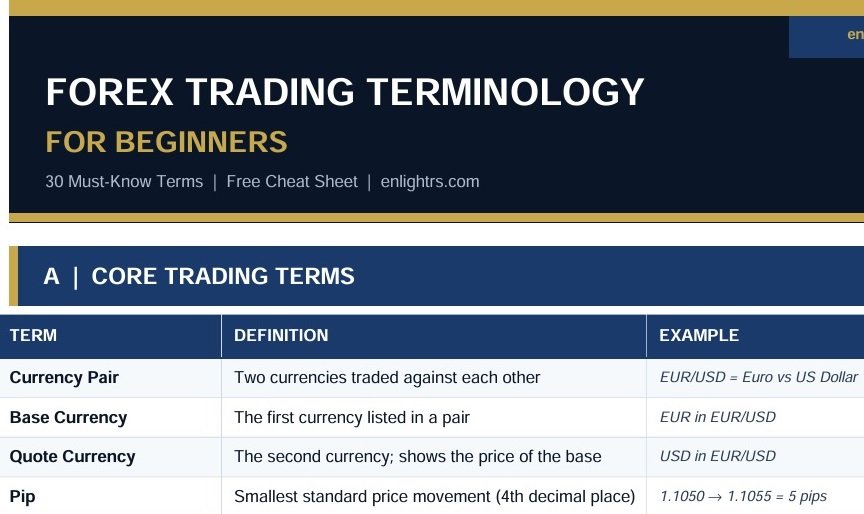
Learning and understanding all these forex terms takes time. On the other hand, if you have the right reference by your side, it makes the process much easier and faster. That is why we created a free, professionally designed forex glossary quick reference guide you can download and keep. It covers all 30 must-know forex terms — from pips and leverage to margin calls and trading sessions. All the terminology are neatly organized into five sections with real examples. Whether you are mid-trade or just starting out, this forex trading dictionary for beginners gives you instant clarity whenever you need it. Download your free forex trading terminology cheat sheet PDF below and never feel lost in the market again.
Conclusion — Know the Language, Trade with Confidence
Learning forex trading terminology for beginners is not just about memorizing words — it is about building the confidence to read the market clearly and make smarter decisions. Every professional trader once sat exactly where you are now. The difference between those who succeed and those who struggle often comes down to how well they understand the language of the market.
So here is your next step: start with a demo account, apply these terms in a real chart environment, and revisit this forex trading dictionary for beginners whenever something is unclear. When you feel ready to go deeper, explore our full guide on how to start forex trading for a step-by-step roadmap. The forex glossary for beginners is your foundation — now it is time to build on it.
Ready to put these terms into practice? Visit our online skills development blog and start your learning journey with discipline and patience in trading today — completely free
Frequently Asked Questions
A trading terminology cheat sheet is a quick-reference document listing the most important forex and trading terms with short definitions. It is designed for beginners to keep handy while learning or actively trading. You can download the free cheat sheet below.
Absolutely. Here are three quick trading term examples: (1) If EUR/USD moves from 1.1000 to 1.1005, that is a 5-pip move. (2) If you use 50:1 leverage, a $200 deposit controls a $10,000 trade. (3) If the bid is 1.1050 and the ask is 1.1053, the spread is 3 pips — your entry cost.
Day trading terms overlap heavily with general forex vocabulary. The most important ones include: pip, spread, leverage, slippage, stop-loss, liquidity, and volatility. Day traders also focus on trading sessions — particularly the London/New York overlap (1 PM–5 PM GMT) — because that window offers the highest liquidity and tightest spreads.
A demo account uses virtual money in a simulated trading environment — there is no financial risk. A real (live) account uses your actual capital, and every gain or loss is real. The market conditions are nearly identical, which makes demo trading the perfect learning ground. Most brokers offer free demo accounts with no time limit.
Slippage in forex is the difference between the price you expected and the price you actually got when your trade was executed. It usually happens during fast-moving markets or major news events.